
We are a cell biology lab that is interested in understanding fundamental pathways of cell physiology and the mechanisms that drive disease. We are situated in the Life Sciences Building on the Highfield Campus at the University of Southampton.
Our current research focuses on investigating the cellular mechanisms and molecular machinery required for subcellular trafficking of membrane associated and cytoplasmic cargo within the endolysosomal and autophagy pathways. These pathways are essential to regulate cell homeostasis by mediating signal regulation, receptor turnover, maintenance of energy stores, degradation of misfolded proteins and damaged organelles, and control of pathogen invasion. Currently our lab has a particular interest investigating the mechanisms of mitochondrial quality control, from whole mitochondrial clearance by mitophagy to repair routes such as the mitochondrial derived vesicle pathway.
Understanding the requirements for cytoplasmic and membrane-associated cargo degradation and their relationship to cell homeostasis is vital to understanding the molecular mechanisms of diseases such as cancer and neurodegeneration, which stem from defects in numerous membrane trafficking and cell signalling pathways. My lab at the University of Southampton utilises cell, molecular, biochemical, and proteomic approaches to investigate these mechanisms associated with vesicle trafficking along the endolysosomal and autophagic pathways in order to further our understanding of these complex interrelationships.
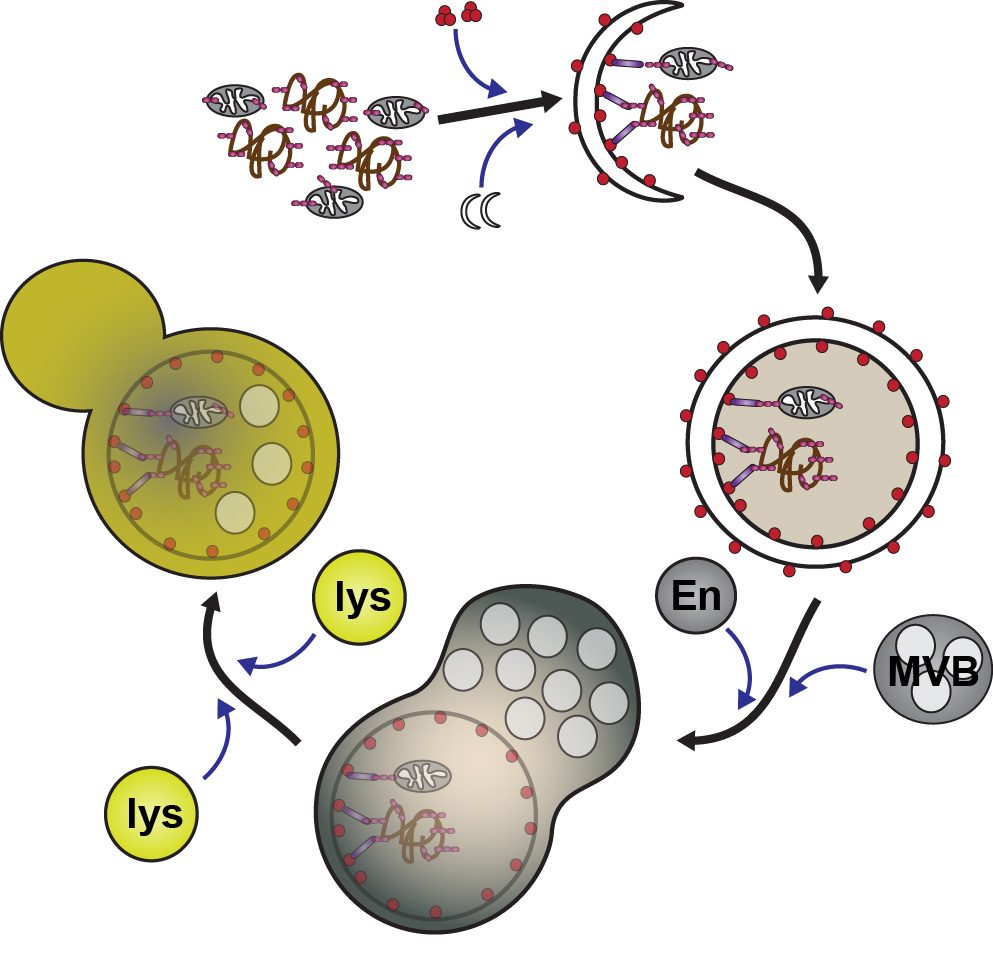
Autophagy pathway
Various ‘cargo’ within the cell, such as damaged organelles, mis-folded proteins, or intracellular pathogens, are tagged with ubiquitin and recognised by selective protein receptors. Subsequently, recruitment of autophagic regulators and formation of the double membrane autophagosome occurs, leading to its maturation following fusion with various vesicular compartments, such as endosomes (En) and multivesicular bodies (MVB). Eventual fusion with the proteolytic compartment, the lysosome (lys), leads to the degradation of cargo and the recycling of the fundamental components.
 Tumbarello lab